Loading...
Serving Carson, CA and surrounding areas. (424) 318-3379
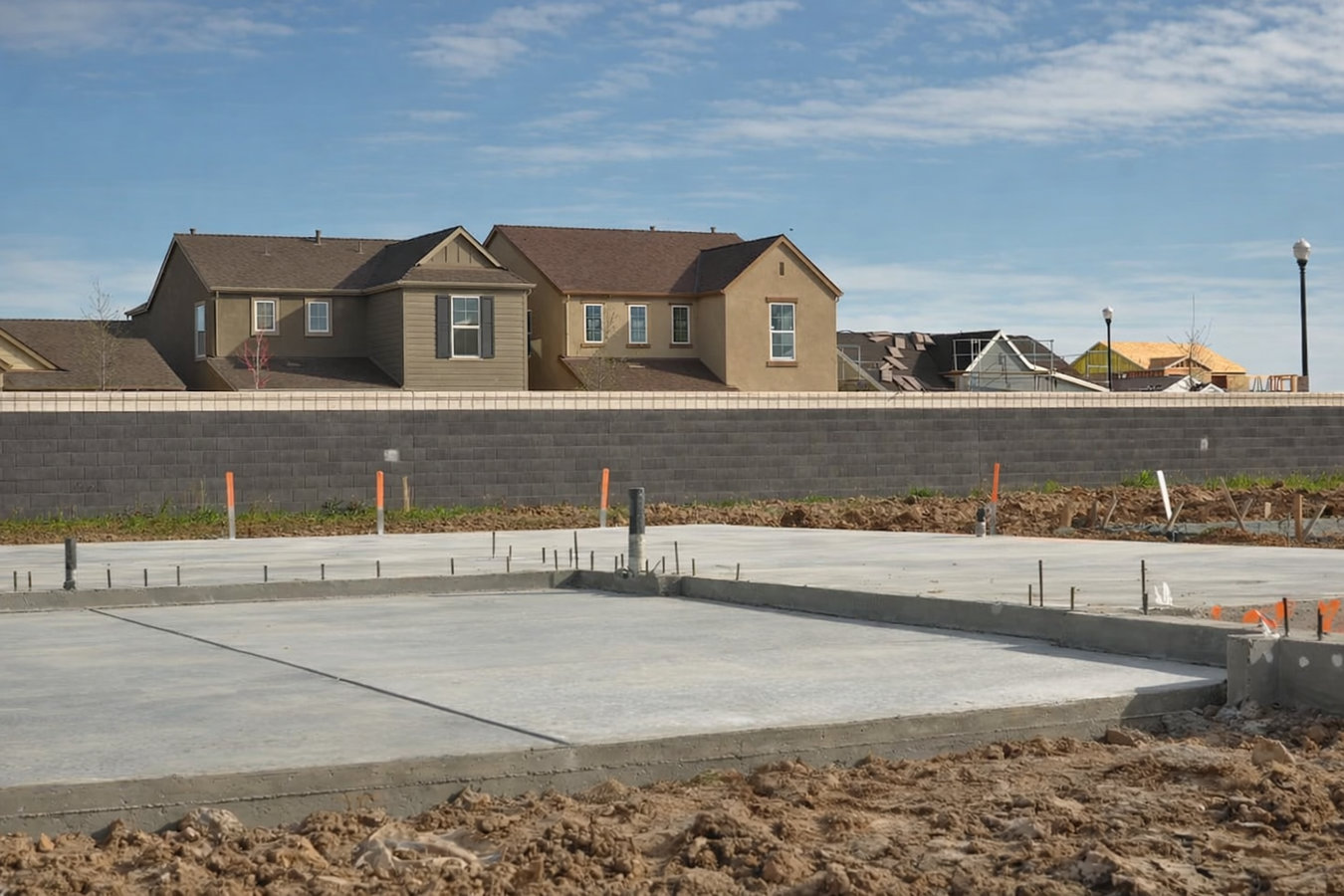
Carson homes sit on clay-heavy ground that shifts every season. We build slab foundations designed for those conditions, fully permitted, steel-reinforced, and inspected before a drop of concrete is poured.
Slab foundation building in Carson means pouring a single, flat layer of reinforced concrete that becomes both the floor and the structural base for your home or addition - most residential projects take one to two weeks of construction once permits are approved, with the slab reaching full strength over the following 28 days.
This is the standard foundation type for Southern California homes, and for good reason - there is no basement to waterproof, no crawl space to maintain, and when it is built correctly for local soil conditions, a concrete slab lasts for decades without problems. The challenge in Carson is that the clay-heavy ground here demands more careful design than a slab in a drier, more stable part of the country.
Slab work is closely tied to other structural concrete. If your project also needs load-bearing support for columns, beams, or fences, our concrete footings service handles that work. For full foundation systems on new homes or major additions, our foundation installation team covers the complete scope from excavation to final inspection.
Small hairline cracks are normal in concrete, but cracks wide enough to slip a pencil into - especially diagonal ones running from door corners - suggest the foundation is moving. In Carson, clay soils shift with every rain cycle, and this kind of cracking is worth evaluating rather than patching and ignoring. A contractor can tell you quickly whether what you see is cosmetic or structural.
When a foundation shifts, the frames around doors and windows shift with it - causing doors to drag on the floor or windows to jam in their tracks. If two or more doors or windows in your Carson home are behaving this way at the same time, that is a reliable early signal that something is happening at the foundation level.
If you can see a gap forming between your floor and the wall at the base of a room, the slab may be settling unevenly. Many Carson homes were built in the 1960s and 1970s on minimally prepared ground, and decades of soil movement can cause gradual separation. This is not always an emergency, but it should be evaluated before it gets worse.
If you are adding a detached accessory dwelling unit, a new garage, or a room addition to your Carson property, a new slab foundation is almost certainly required. California's push to add housing has made ADU construction common in Carson, and a properly permitted slab is the starting point for any new structure on your lot.
Every slab we pour in Carson starts with a soil assessment - not because the code requires it in every case, but because the clay-heavy ground here directly shapes how the foundation needs to be designed. We grade and compact the site, lay a gravel base, install a plastic moisture barrier, and place a steel reinforcement grid before any concrete is ordered. The perimeter beams are poured deeper than generic national standards call for, which is what keeps slabs stable through Carson's wet-dry soil cycles and seismic activity. We pull the City of Carson building permit before work begins, and a city inspector reviews the steel and forms before the pour - that independent checkpoint is built into every project.
If your project involves structural supports that tie into the slab - posts, columns, or anchor bolts for a pergola or outbuilding - our concrete footings work is scoped alongside the slab so the whole structure is built as one coordinated system. For homeowners building a complete new home or major addition, our foundation installation service covers the full scope from geotechnical review through county sign-off.
For new home construction or full foundation replacements where a properly engineered, city-permitted slab is required from the ground up.
For Carson homeowners adding a detached unit, garage, or room addition who need a standalone slab that meets current California ADU requirements.
For detached garages, workshops, or outbuildings that need a level, reinforced concrete floor to support vehicles or equipment loads.
For sections of an existing slab that have cracked, settled, or failed due to soil movement, and where replacing the full slab is not practical or necessary.
Carson was built out mostly in the 1960s and 1970s, and the original slabs in many of those homes were poured on ground that was not always prepared to today's standards. The soil in much of Carson - and across the South Bay more broadly - is clay-heavy. That means it swells when the winter rains come and shrinks back down as the dry season sets in. A slab that was not designed with that movement in mind will show stress cracks within a few years, regardless of how solid it looks on pour day. Carson also sits in an active seismic zone, which means California's building code requires more steel reinforcement and deeper perimeter beams than you would see on a comparable project in a lower-risk state. These are not paperwork requirements - they are what the ground here actually demands.
The City of Carson's Building and Safety Division requires a permit and a pre-pour inspection for every new slab, and that process typically adds one to three weeks to the timeline. Homeowners who do not plan for that step are often surprised by the delay. We handle the application and inspection scheduling as part of every project. We serve Carson and the surrounding South Bay, including homeowners in Compton and Long Beach, where similar soil and seismic conditions mean the same careful approach applies.
Reach out by phone or the contact form and we will reply within one business day. We schedule a free on-site visit before giving you any number - site access and soil conditions in Carson vary enough that a phone quote is not reliable.
We assess the soil conditions at your property - often through existing county records plus a site evaluation - and submit the permit application to the City of Carson. Permit approval typically takes one to three weeks, so we start this step as early as possible.
Once the permit is approved, the crew grades and compacts the site, installs forms, lays the moisture barrier, and places the steel reinforcement grid. A City of Carson inspector reviews the work before any concrete is ordered.
The concrete truck arrives and the crew pours, levels, and finishes the slab in a single operation. You will be asked to keep the area clear for 24 to 48 hours. The slab reaches working strength in about a week and full strength over 28 days - your contractor will advise on when construction above it can resume.
Free on-site estimate. We handle the City of Carson permit and inspection. No deposit until work is scheduled.
(424) 318-3379We start every slab project with a soil assessment specific to your lot. Clay-heavy ground in the South Bay expands and contracts with the seasons, and a slab designed without accounting for that will crack. We build in the footing depth and steel reinforcement that Carson's ground actually requires.
The City of Carson requires a pre-pour inspection on every new slab - an independent city inspector must sign off before we order concrete. We submit the permit application, coordinate the inspection, and keep you informed at every step so you are never chasing paperwork.
California's seismic requirements for the Los Angeles area mean more steel and deeper footings than are required in most other states. We build to those standards on every pour - not as an upgrade, but as the baseline. The American Concrete Institute guidelines at concrete.org set the professional standard we follow.
We work across 12 cities in the South Bay and greater Los Angeles area, including Carson, Torrance, Compton, and Long Beach. That volume means we know the local permit offices and inspection processes well, which keeps projects moving on schedule.
Every slab we build gets a city inspection before the pour and full documentation after the final sign-off. That paper trail protects your investment and makes your home easier to sell or insure down the road.
For more on concrete standards and curing best practices, see the Portland Cement Association and the California Contractors State License Board.
Complete foundation systems for new homes and major additions, from excavation and engineering review through county permit sign-off.
Learn moreIndividual load-bearing footings for posts, columns, fences, and structural supports that tie into or sit alongside your slab.
Learn morePermits fill up fast at the City of Carson - reaching out now locks in your timeline before the busy season.